01 / THE BASICS
What is a wedge wire screen?
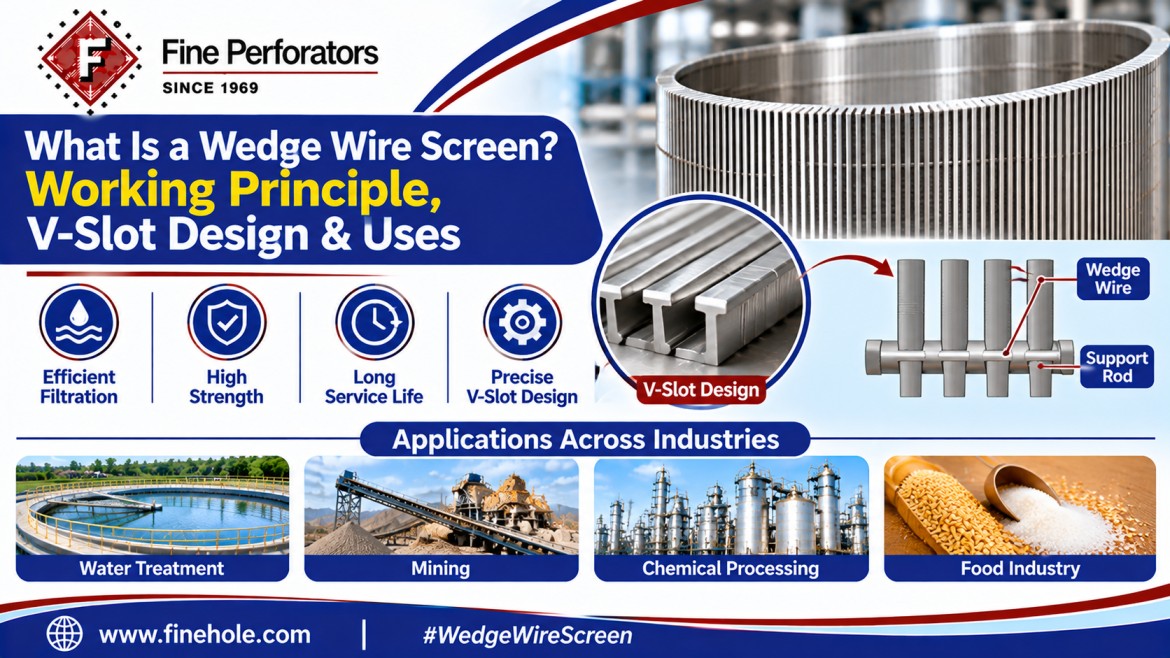
A wedge wire screen is an industrial filtration product made by welding shaped V-profile wires onto support rods. The spaces between the wires create uniform slots: liquids pass through while particles larger than the chosen opening stay on the screening surface.
Unlike conventional wire mesh, the V-shaped profile creates a slot that widens beneath the screen surface. That geometry helps particles move through rather than wedge tightly into an opening. Depending on the equipment and application, screens can be manufactured as flat panels, cylinders, baskets, or curved sections. A properly specified wedge wire filter screen can help deliver consistent separation in demanding operating conditions.
02 / HOW IT WORKS
How does a wedge wire screen work?
The principle is straightforward: process liquid flows through the precisely sized slots, while solids that are too large to pass are retained. The opening narrows at the outside face and broadens toward the inside, so trapped particles are less likely to lodge deep in the screen.
This continuous slot profile can support smooth flow and help reduce blockage during ongoing operation. Actual filtration performance depends on slot size, wire profile, material, operating pressure, and the properties of the liquid and particles being processed.
03 / DESIGN DETAIL
Understanding V-slot design
V-shaped wires are welded across support rods at carefully controlled intervals. At the screen surface, the narrow slot defines the separation point; below it, the passage widens. This construction combines accurate openings with sturdy support.
- 01
Less clogging
The widening internal passage makes it harder for particles to become wedged inside the slot. - 02
Steady flow
Continuous openings provide an effective path for the liquid being screened. - 03
Accurate separation
Slot widths can be selected to suit the filtration requirement. - 04
Robust construction
Welded wires and support rods provide structural stability for industrial use.
04 / WHERE THEY’RE USED
Applications across industries
Their adaptable shape, strong construction, and accurately sized slots make wedge wire screens useful in a wide range of solid–liquid separation processes.
Water treatment
Screen suspended solids and debris ahead of further treatment.
Chemical processing
Support solid–liquid separation where material compatibility matters.
Food & beverage
Assist with product separation, washing, clarification, and filtration.
Sugar production
Separate liquids and solids across sugar-processing operations.
Mining & minerals
Provide sturdy screening for demanding mineral-processing work.
Pulp & paper
Separate fibres and other materials during production.
Where a process handles industrial liquids, a wedge wire screen can provide controlled particle separation while maintaining the flow required by the operation.
05 / SPECIFICATION
How to choose the right screen
Start with the process requirements and the equipment the screen must fit. These details help narrow the design:
- Slot openingMatch the opening to the particle size you need to retain.
- Material gradeConsider the process fluid, chemicals, and operating environment.
- Wire profile & supportsChoose a construction suited to the screen’s load and filtration needs.
- DimensionsConfirm diameter, length, thickness, and the equipment interface.
- Operating conditionsAccount for temperature, pressure, fluid composition, and solids concentration.
Stainless-steel grades such as SS 304 and SS 316 are used for different conditions; the appropriate material depends on the application and process-fluid compatibility.
06 / ABOUT THE MANUFACTURER
Filtration solutions by Fine Perforators
Fine Perforators has manufactured industrial screening and filtration products since 1969. Because every process has different requirements, slot opening, material grade, dimensions, and operating conditions all matter when selecting a suitable screen.
From water treatment to chemical processing and sugar production, discuss your application and technical requirements with the Fine Perforators team to explore a suitable configuration.